

Macro and
Equity Market
Outlook
Equity Market
Outlook
GLOBAL MACRO & MARKETS
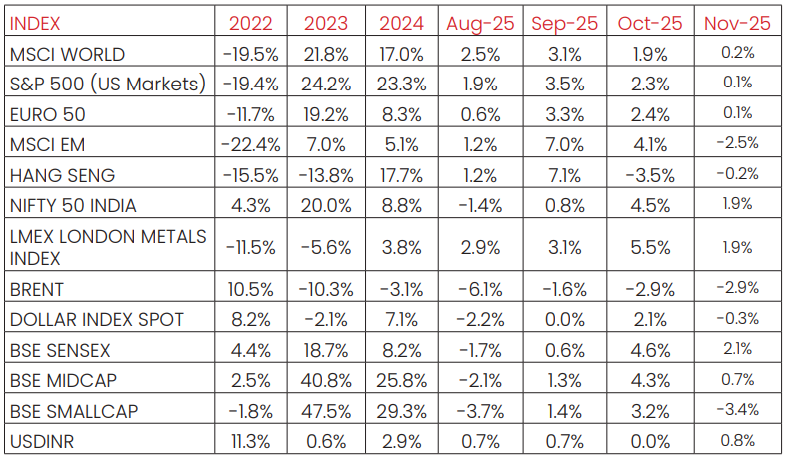
India’s NSE NIFTY 50 index ended the month of November 2025 in
green (+1.9%). Among major global indices, the S&P 500 (+0.1%), the
Morgan Stanley Capital International (MSCI) World (+0.2%) and the
Euro 50 (+0.1%) ended the month of November 2025 with positive
returns while the Japanese NIKKEI (-4.1%) ended the month of
November 2025 with negative returns. Performance was mixed
among Emerging Markets (EM) indices, with the Morgan Stanley
Capital International Emerging Markets (MSCI EM), Hang Seng,
BOVESPA Brazil recording sequential returns of (-2.5%), (-0.2%), and
(+6.4%) respectively.
The London Metals Exchange (LME) Metals Index rose (+1.9%) in
November 2025, as global trade tensions remained volatile. West
Texas Intermediate (WTI) and Brent Crude fell MoM, by (-4.0%) and
(-2.9%), respectively, as markets remained cautious given tariff
uncertainties and geopolitical concerns.
The Dollar index fell (-0.3%), through November 2025, with the US
Dollar (USD) depreciating vis-à-vis Emerging Market (EM)
currencies (+1.0%) and appreciating against the Indian Rupee (INR)
on the spot market (+0.8%). India 10Y G-Sec yields fell by 2.6 bps,
while US 10Y G-Sec yields fell by 6.43 bps, and the German Bund
yield rose by 5.6 bps, with rates settling at 6.50%, 4.01% and 2.69%,
respectively.
Domestic Macro & Markets
The BSE SENSEX rose (2.1%) in November 2025, in line with the NSE
NIFTY Index. Both the BSE Mid-cap index and the BSE Small-Cap
index underperformed the BSE SENSEX, rising by (+0.7%), and falling
by (-3.4%) over the month, November 2025, respectively.
Sector-wise, Technology, Information Technology & Automobiles
were the top outperformers over the month, November 2025
clocking (+3.9%), (+3.7%) and (+3.1%) respectively. Six out of BSE
Sensex’s 13 major sectoral indices ended the month of November
2025 in green.

Net Foreign Institutional Investors (FII) flows into equities were
Negative for November 2025 (post 3 consecutive months of
outflows totalling $8.75 Bn) at (-$0.42 Bn), following (+$1.65 Bn) in
October 2025. Domestic Institutional Investors (DIIs) remained net
buyers of Indian equities for the 27th consecutive month with flows
of (+$8.67) Bn in November 2025 compared to (+$5.97) Bn last
month.
India's high frequency data update:
Record levels of Goods and Services (GST) collections, stable retail
inflation, deflated input inflation, rising core sector outputs, and
elevated credit growth augurs well for the Indian economy.
Purchasing Managers’ Index Manufacturing PMI:
India’s Purchasing Managers’ Index Manufacturing (PMI) in November
2025 fell to 56.6 from 59.2 in October 2025, continuing to remain in the
expansion zone (>50) for the 51st straight month. The figure remained
well above the long-term average (LTA), signalling continued strength
in the sector. However, the latest reading reflects softer new order
inflows amidst challenging market conditions.
Goods and Services Tax (GST) Collection:
Gross collections of INR 1.70 Tn (+0.7% YoY) in November 2025
concluded the forty fourth consecutive month of collections over
the INR 1.4 Tn mark. The modest growth validates the government’s
Goods and Services Tax (GST) 2.0 strategy, with November 2025
collections reflecting business activities of October 2025
showcasing the first full month of post-rate cut festive buying.
Core Sector Production:
The index of eight core sector industries remained flat (0% YoY) in
October 2025, against a (+3.3%) growth in September 2025. Four
out of eight constituent segments grew YoY, driven by Fertilizers
(+7.4% YoY), Steel (+6.7% YoY), Cement production (+5.3% YoY) &
Refinery Products (+4.6% YoY).
Industrial Production:
Factory output growth as measured by the Index of Industrial
Production (IIP) grew YoY to (+0.4%) in October 2025, vs a growth of
(+4.0%) YoY in September 2025. The slow growth in the month of
October 2025 could be attributed to lesser number of working days
because of a number of festivals in the month including Dussehra,
Diwali and Chhath, driven by negative growths in 2 of 3 major
sectors- Mining (-1.8% YoY), Manufacturing (1.8% YoY) and Electricity
(-6.9% YoY).
Credit growth:
Scheduled Commercial Bank Credit growth for October 2025 rose
to (+11.4%) YoY vs (+10.7%) YoY as of September 2025. Agriculture
and allied activities credit in September 2025 was stable at (+8.9%)
YoY, while industrial sector credit grew by (+10.0%) YoY, the services
sector credit grew by (+13.0%) YoY.
Inflation:
October’s 2025 Consumer Price Index (CPI) inflation rate
decelerated MoM to 0.25% (the lowest since June 2017), down from
(-1.44%) in September 2025. Food inflation slowed YoY to (-5.02%),
down from (–2.33%) in the previous month of September 2025 but
remaining negative for the Fifth consecutive month. The Wholesale
Price Index (WPI) inflation fell sequentially in October 2025, with the
print at (-1.21%) YoY, primarily due to decrease in prices of food
articles, crude petroleum & natural gas, electricity, mineral oils and
manufacture of basic metals etc.
Trade Deficit:
Indian Merchandise Exports fell by (+11.8%) YoY to $34.4 Bn in
October 2025, while Imports rose by (+16.6%) YoY to $76.1 Bn.
Merchandise trade deficit rose to an all-time high of $41.7 Bn
growing (+59.16%) YoY. The increase in imports was primarily owing
to the tripling in gold imports aided by festive demand and
possibly speculative/investment demand higher prices, as well as
a robust 12.4% growth in non-oil non-gold items. The widening
deficit was exacerbated by recent U.S. tariff hikes on Indian goods,
which affected key export sectors such as textiles, shrimp, and
gems.
Events to watch out for in December 2025:
Trade Related News flow:
Tariff news flow remains volatile, with
changes to be monitored closely by the markets. Indian bilateral
agreements to be watched.
Federal Open Market Committee (FOMC Meet):
The US Federal
Reserve announced a 25bps interest rate cut to the range of
3.75%-4.00% after its two-day policy meeting ended on 29 October
2025. The US Federal Reserve also said that the central bank will
now be focusing on the balance of risk in the US economy, along
with the evolving outlook and the incoming data, to further decide
on the future route of the key interest rates. The next FOMC meet is
scheduled for 9-10th December, 2025.
Other things to watch out for:
Oil Market volatility with the
Organization of the Petroleum Exporting Countries (OPEC+)
increasing production and Post Festive Season Demand
normalisation.
Monthly Performance for Key Indices:
Source:NIMF Research, Bloomberg
.*Calendar year returns.
Note:Market scenarios are not reliable indicators for current or future performance. The same should not be construed as investment advice or as any research report/research recommendation
Past performance may or may not be sustained in future.
Note:Market scenarios are not reliable indicators for current or future performance. The same should not be construed as investment advice or as any research report/research recommendation
Past performance may or may not be sustained in future.
Market View
Indian equity markets while touching new highs have been largely
flattish the last year or so.
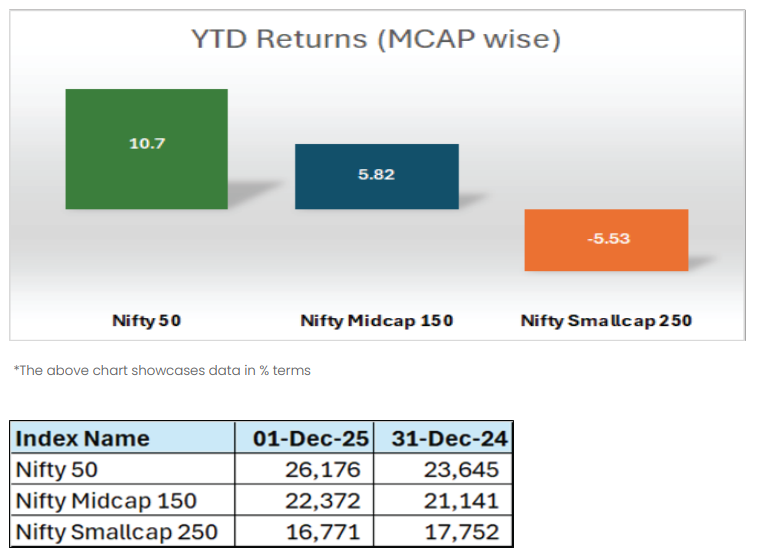
Markets have witnessed a narrow trend with large cap indices like
Nifty 50 outperforming the broader markets on a YTD basis.
Few discretionary themes across Quick Commerce, Personal
Products, Retail, and some Capex plays have witnessed sharp
correction even as markets have been mostly flat last 1 year.
The policy makers have been focused to revive domestic growth
through host of supportive measures like lower interest rates,
reduced tax rates for middle income households and
rationalization in Goods and Services Tax (GST) rates.
GST cuts and Income tax rationalisation has kept sentiments
positive. Some sectors have benefited from these changes –
mostly on discretionary side. Long term benefits of GST cuts are
likely to accrue.
2Q results reflect core earnings and revenues growing 8-9% for the
overall market with mid cap earnings doing better. Large cap and
small cap earnings growth was lagging in 2Q season.
Earning next 1-2 years can trend higher due to the domestic
support and solution on tariffs.
Better valued sectors like Banking are seeing Foreign Fund
participation. Some moderation in foreign fund outflows is visible.
Whereas on the domestic end, the flows remain steady through
SIPs which has seen some growth.
Global macro uncertainty persists along with the geo-political
development and may lead to higher volatility in the near term.
Asset allocation in line with the risk appetite of the investor is an
important tool to navigate any unanticipated volatility. While
valuations have moderated from the peaks of last year, overall
economic recovery and the global uncertainties needs to be
monitored in this regard Large Cap & Large Cap oriented
diversified strategies along with hybrid funds appear to be better
placed on risk-reward basis, while Mid/Small cap allocation may
be considered in a staggered manner through systematic
investment with a long-term view.
Chart of the Month:
Large Caps outperform broader markets in CY 2025*
Source:
NIMF Research, Bloomberg
Disclaimer:
The current fund philosophy may change in future depending on market conditions or fund manager’s
views. The
sectors mentioned are not a recommendation to buy/sell in the said sectors. The scheme may or may
not
have future
position in the said sectors.
The information herein above is meant only for general reading purposes and the views being
expressed
only constitute
opinions and therefore cannot be considered as guidelines, recommendations or as a professional
guide
for the
readers. The document has been prepared on the basis of publicly available information, internally
developed data and
other sources believed to be reliable. The sponsors, the Investment Manager, the Trustee or any of
their directors,
employees, Associates or representatives (‘entities & their Associate”) do not assume any
responsibility for, or warrant
the accuracy, completeness, adequacy and reliability of such information. Recipients of this
information are advised to
rely on their own analysis, interpretations & investigations. Readers are also advised to seek
independent professional
advice in order to arrive at an informed investment decision. Entities & the associates including
persons involved in the
preparation or issuance of this material, shall not be liable in any way for any direct, indirect,
special, incidental,
consequential, punitive, or exemplary damages, including on account of lost profits arising from the
information
contained in this material. Recipient alone shall be fully responsible for any decision taken on the
basis of this document