When market dynamics change, diversification matters.
Investors often ask a simple question:
which asset class should I invest in? The honest answer is that the question itself may be incomplete. Financial markets are shaped by changing economic conditions, evolving valuations, policy decisions and investor sentiment. As these factors change, different asset classes lead at different times.
Rather than relying on a single asset class, investors may consider an approach that brings together different asset classes within one portfolio.
One portfolio. Multiple asset classes.
Each may move to a different rhythm, respond to a different set of drivers, and might play a different role depending on where the cycle stands.

Equities
Ownership stakes in businesses. Investments are spread across selected companies.

Debt
Investments in fixed income instruments. May be considered for potential income generation and relative stability.

Commodities
Precious metals in particular have traditionally attracted interest during inflationary periods or heightened market uncertainty.

Infrastructure Investment Trusts (InvITs)
Infrastructure Investment Trusts may provide exposure to income-generating infrastructure assets and long-term structural growth.
Each asset class may contribute differently to the overall portfolio.
Bringing these asset classes together allows the portfolio to draw upon their differing characteristics instead of relying on a single source. This is where diversification and asset allocation assume significance. Instead of depending on a single investment theme or market segment, they may provide a framework for participating across changing market environments.
The question
Can one predict which asset class may lead next?
If investing were predictable, portfolio construction would be simple.
An investor could identify tomorrow's best-performing asset class today, and allocate everything to it. But markets don't work that way.
The honest position
There may be periods when equities may take centre stage. At other times, debt may provide relative stability. Commodities may play their part in certain environments, and infrastructure linked assets may create opportunities of their own.
No analyst or model knows with certainty which asset class might lead next. That isn't a flaw investors need to work around.
It is simply how markets behave.

Market leadership does not follow a fixed pattern
One of the enduring features of financial markets is that leadership changes over time. Different asset classes respond differently to inflation, interest-rate movements, liquidity conditions, corporate earnings and economic growth. Consequently, periods of outperformance may tend to shift rather than remain concentrated within a single segment of the market.
No single asset class stays at the top every year.
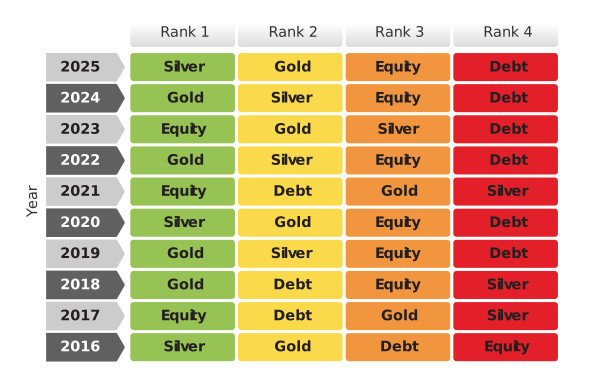
Note: 1) For Gold, domestic price of Gold is considered. 2) For Silver, Silver Price MCX returns are considered. 3) For Equity, BSE 100 TRI returns are considered. 4) For Debt, CRISIL Short Term Bond Fund Index returns are considered. 5) Source: Bloomberg and MFI Explorer.
The table above illustrates this changing pattern. Over successive calender years various asset classes have performed differently and accordingly their position has also got varied. The exercise is not intended to identify the "best" asset class. Instead,
it demonstrates that leadership has historically rotated across market cycles.
For investors, this highlights an important consideration. Portfolios concentrated in a single asset class remain closely linked to the fortunes of that asset class.
Diversified portfolios, on the other hand, are positioned to participate across a broader range of market opportunities.
Portfolio construction is about more than investment selection
Investors often spend considerable time deciding what to invest in. Which stock, which fund, which sector? The bigger, quieter questions tend to matter more.
- How much should be allocated to each asset class?
- When should allocations be reviewed?
- How can portfolios remain aligned with long-term goals as markets change?
Allocations also don't stay put on their own. If one asset class may perform well over time, it naturally comes to occupy a larger share of the portfolio, while another is gradually underrepresented.
As a result, the portfolio may no longer reflect the intended mix of asset classes.
That is why a multi-asset investment approach involves two closely related principles.

Diversification
Diversification means spreading out the investments among different asset classes, avoiding the dependence on one factor. Different assets react to changes in the market in different ways. Diversification tries to minimise concentration and expand the participation in the investment process.

Asset Allocation
Asset allocation helps in determining the way the investments will be distributed among asset classes in the portfolio. Asset allocation helps in implementing diversification.
Together, these two principles encourage disciplined approach to investing across changing market conditions.
The solution
Hybrid Funds
Hybrid Funds combine diversification and asset allocation within a single investment. They are structured to combine multiple asset classes within a single portfolio. Depending on the category, they may invest across equity, debt, commodities and InvITs.
The rationale is straightforward. Combine the asset classes:

Equity
Performance may be influenced by corporate earnings, business growth, market valuations and investor sentiment.

Debt
Returns may be shaped by interest-rate movements, monetary policy and prevailing credit conditions.

Commodities
May respond to inflation expectations, geopolitical developments and global supply-demand dynamics.

InvITs (Infrastructure Investment Trusts)
Invest in infrastructure assets through a pooled investment vehicle.
Combining these asset classes may seek to create a portfolio that is less dependent on the performance of any single market or asset class. Decisions relating to asset allocation, portfolio monitoring and periodic rebalancing are undertaken within the framework of the scheme's investment objective. This enables investors to access diversified portfolios without independently managing multiple investments across different asset classes.
Hybrid Funds therefore represent more than a combination of securities.
They represent an investment approach built around diversification and asset allocation.
What Hybrid funds give investors
 Exposure across multiple asset classes
 Diversification through one portfolio
 Professional management
 Simplicity, without managing investments separately
Explore some of the Hybrid Fund Categories
Balanced Hybrid Funds
Balanced Hybrid Funds make investments in both equities and debts and ensure the allocation stays within certain regulatory levels. This may be considered for those who want to invest in equity investments, while also accessing the potential features of debt investment.
Balanced Advantage Fund
Balanced Advantage Funds allocate to equities and debt according to an already defined investment policy. This may help the fund adapt itself to the changing market situation.
Multi Asset Allocation Funds
Multi Asset Allocation Funds make investments in at least three asset classes. Depending on the investment strategy, these portfolios may include equity, debt, commodities and other permitted asset classes such as InvITs.
Equity Savings Funds
Equity Savings Funds combine equity investments, arbitrage strategies and debt securities within a single portfolio. The strategy may seek to bring together different investment approaches while maintaining equity-oriented exposure, subject to prevailing tax regulations.
SEBI classifies Hybrid Funds as a mutual fund category comprising different scheme categories designed to cater to varied investment objectives. Each follows a different mandate, but they share one aim: combining different asset classes within a professionally managed framework.
Markets change.
Your investment approach might be ready to adapt.
Markets evolve continuously. Economic conditions change, policy environments shift and leadership across asset classes adjusts accordingly. These changes cannot be eliminated, but they may be acknowledged within the way a portfolio is constructed.
Hybrid Funds are designed around this principle. By combining multiple asset classes and embedding asset allocation within the investment process, they seek to create portfolios capable of participating across different market environments rather than depending on a single investment outcome.
For investors seeking a disciplined approach to diversification, Hybrid Funds may offer a structured investment framework.
GO HYBRID.
Contact your Mutual Fund Distributor or Investment Advisor | Give us a missed call on
8000112244
Note: Investment by hybrid schemes in INViTS will be subject to guidelines prescribed by SEBI from time to time.
