In today’s fast-paced world, most things are available at the click of a button. By the magic of smartphones and mobile apps, you can order food and groceries online, call for taxis and auto rickshaws online, and even conduct banking transactions online. All these tech developments have made day-to-day life quite hassle-free and convenient. Little wonder then that the digital bug has bitten the mutual fund industry too, making it quite easy for investors to invest in a variety of schemes of their choosing online.
The Rise of Online Investing and Digital-First Financial Planning
Digital investment platforms, also called robo-advisors or online wealth management tools, have played a crucial role in transforming the financial planning landscape. These platforms leverage technology, data analytics, and user-friendly interfaces, thereby facilitating access to investment opportunities, reshaping traditional advisory roles, and also ushering in financial inclusivity.
Key Advantages of Mutual Fund Growth in a Digital Economy
The advent of online mutual funds has completely transformed how individuals invest, as the processes have become more streamlined, cost-effective, and accessible. These are some of the ways by which both seasoned investors and beginners benefit:
● Online mutual funds offer seamless account setup processes, eliminating the need for extensive paperwork. Features such as e-KYC (Know Your Customer) and user-friendly interfaces provide investors knowledge of various fund schemes, guiding them in the selection process, purchase of units, and portfolio tracking.
● Online mutual funds allow investors to manage their portfolios from the comfort of their homes or on the go. Through mobile apps and websites, investors can invest, redeem, or switch funds instantly.
● Online availability of mutual funds streamlines the fund selection process with tools and resources that enable investors to make informed decisions. These tools include performance trackers that provide historical data, analysis of trends, and comparison features that may help compare various schemes.
● Fund houses, often, offer educational resources to help investors understand how mutual funds operate. This may be particularly beneficial to first-time investors.
Regulatory Protections: Why Mutual Funds may tend to be a Trusted Choice
Mutual funds place significant emphasis on regulatory compliance. Fund houses ensure that the various schemes they introduce align with SEBI's mutual fund regulations and they also adopt robust protocols to safeguard investor information. These SEBI regulations cover various aspects of mutual fund operations, such as registration, investment limitations, disclosure obligations, and measures to protect investors. Adhering to these guidelines is a fundamental requirement for asset management companies (AMCs) and other players in the mutual fund sector to promote transparency, and fairness, and maintain investor confidence.
Adopting robust security protocols protects investors against cyber threats and ensures the integrity and confidentiality of the information they provide. One such cyber threat that investors face is fishing, whereby they are tricked into revealing personal information such as login details, passwords, or even credit card numbers. AMCs typically provide information/education on the nature of these scams and how investors must be careful of them.
Choosing the Right Online Mutual Funds for Diverse Financial Goals
Here are some tips for selecting online mutual funds that will likely align with an investor’s investment objectives:
Know your goals:
Determine your goals first so that you get a fair idea of why and for how long you plan to invest. For instance, debt funds might be suitable if you have a short-term horizon, while if you are looking to invest for the long term while aiming to building wealth, meeting large expenses, or even retirement, you may consider equity funds. Equity funds tend to be riskier than debt funds but can generate better potential returns.
Risk appetite:
If you have a low-risk appetite, debt funds or money market funds might work for you. For moderate-risk investors, equity funds that focus on large caps such as the Nippon India Large Cap Fund, are an option they may consider. Investors with a higher risk appetite looking for potential returns while willing to take on more risks could look at small-cap or mid-cap equity funds.
Understanding various funds:
Mutual funds are required to state the objectives of the various schemes they launch. Furthermore, they also provide historical data, and past fund performance for various periods that give a fair idea of the history of the fund, its objectives, and its performance. Investors must take their time to understand this data, compare various funds, and then make an informed decision.
Compare expense ratios:
Expense ratios are nothing but the expenses the fund incurs to manage the investors’ money. This is expressed as a percentage. If this is a critical factor for you, you can again compare various fund schemes to get an idea of which funds have the lowest expense ratio and decide accordingly.
All of this data can be readily accessed online on the websites of mutual funds or other portals making it easier for investors to make suitable decisions.
The Future of Mutual Fund Investment in a Digital-Driven World
Going forward, the mutual fund industry could likely change as new technologies like fintech and artificial intelligence (AI) gain pace. Partnerships between AMCs, fintech companies, and technology providers could help in creating digital platforms that can offer a wide range of financial services in one place. Technologies like blockchain and machine learning could help AMCs manage investments better, making compliance tasks easier through automation, and providing personalised investment options based on each investor’s needs. At the same time, digital payment systems will likely make it easier to transfer funds and complete transactions. These improvements will not only save time but also make mutual fund services simpler and more accessible for everyone.
Conclusion
Thanks to easy accessibility, cost efficiency, transparency, and personalisation, mutual funds have the potential to be an investment option for a diverse set of investors. Depending on their risk appetite and financial goals, investors can make an informed decision on selecting funds that best align with their overall investment objectives.
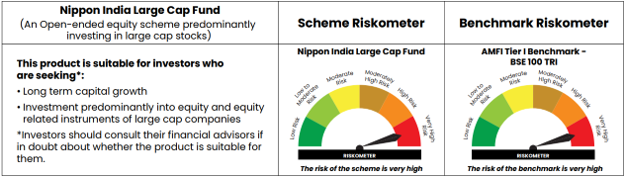
Product Label – Nippon India Large Cap Fund (An Open-ended equity scheme predominantly investing in large cap stocks)
Current investment strategy is based on the prevailing market conditions and is subject to changes depending on the fund manager’s view of the markets.
Disclaimer:
The information herein is meant only for general reading purposes and the views being expressed only constitute opinions and therefore cannot be considered as guidelines, recommendations or as a professional guide for the readers. The document has been prepared on the basis of publicly available information, internally developed data and other sources believed to be reliable. The sponsor, the Investment Manager, the Trustee or any of their directors, employees, associates or representatives (“entities & their associates”) do not assume any responsibility for, or warrant the accuracy, completeness, adequacy and reliability of such information. Recipients of this information are advised to rely on their own analysis, interpretations & investigations. Readers are also advised to seek independent professional advice in order to arrive at an informed investment decision. Entities & their affiliates including persons involved in the preparation or issuance of this material shall not be liable in any way for any direct, indirect, special, incidental, consequential, punitive or exemplary damages, including on account of lost profits arising from the information contained in this material. Recipient alone shall be fully responsible for any decision taken on the basis of this document.
Mutual Fund Investments are subject to market risks, read all the scheme related documents carefully.
